2026-08-29T14:03:15.563Z ·
Water Damage In A Pinal County Slab Home: Where The Water Actually Goes
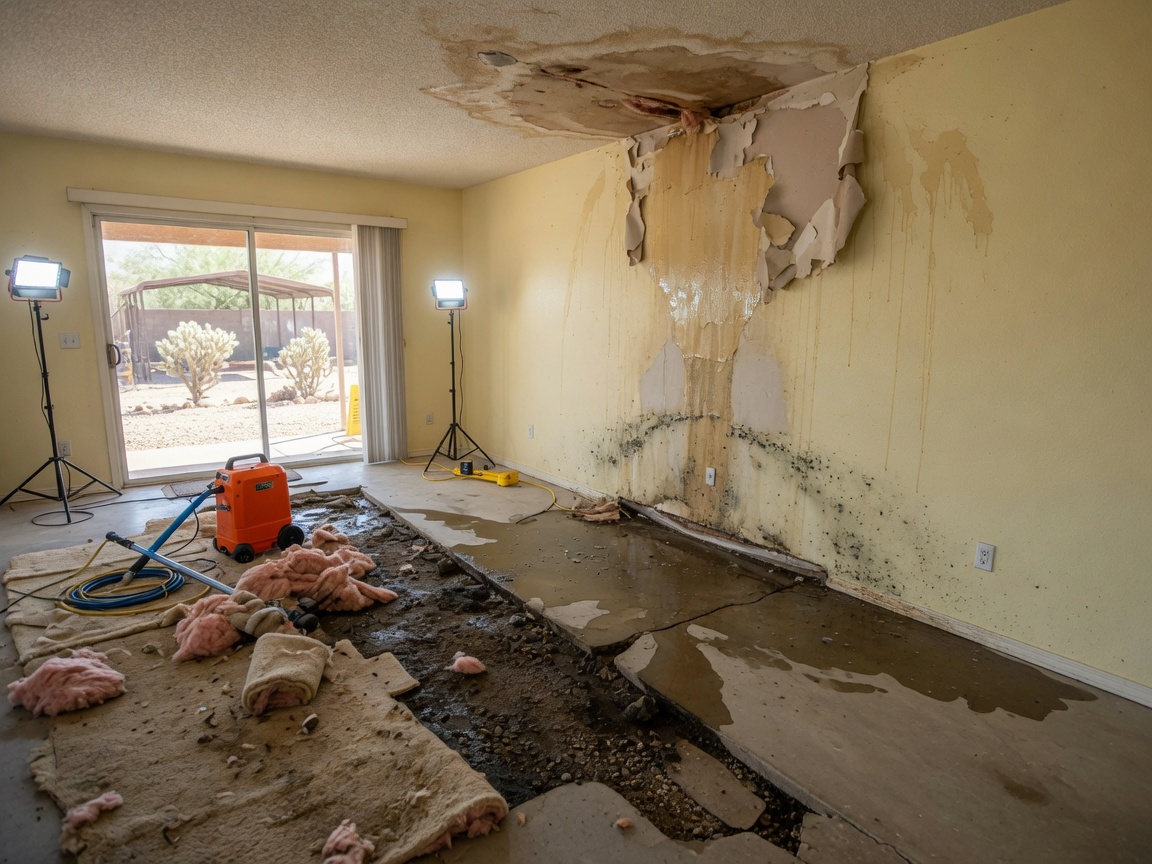
Ask somebody from the midwest where water goes after a burst pipe and they will say the basement. In Casa Grande there is no basement, and that changes everything about finding it.
Water on a slab spreads outward instead of downward. It runs along the surface until it meets a floor covering that will take it, then it goes underneath. Under tile it travels along the thinset and the grout lines. Under laminate it moves through the seams and swells the boards from below. Under carpet it goes straight into the pad, which acts like a sponge and holds several times its own weight, which is why extraction means pulling pad rather than mopping a floor.
Then it climbs. Drywall wicks moisture upward from the bottom plate at a rate people find hard to believe, four to six inches in the first day for a wall standing in water. That is why a room can look completely untouched, feel dry underfoot and still have a wall reading wet at the base, and why structural drying gets metered room by room instead of guessed at.
The rooms to check are the ones sharing a wall with the source and anything downhill of it. Slabs are not perfectly level, and water follows the fall. We have pulled baseboard in a bedroom two rooms away from a laundry leak and found the plate soaked while the laundry itself had already surface dried. Water coming up from underneath instead of across the floor is a slab leak, and it announces itself with a warm patch and a high water bill rather than a puddle.
The practical version for a homeowner: after any leak, press a fingertip to the drywall at the very bottom of the wall in each nearby room. Soft, cool or slightly spongy means wet, and it means there is more going on than the puddle you mopped. Left alone past about two days, that hidden moisture is how a drying job turns into a mold job.
None of this applies the same way to a manufactured home, where the floor is a sealed sandwich rather than concrete. That version is its own problem.
For a proper answer somebody needs a meter on it, and that is a short visit rather than a project. Call (520) 679-8658 and we will tell you what the numbers say.